



Joint pain is a common problem that can affect people of all ages. It may develop after an injury, repetitive strain or age-related wear and tear, and can affect almost any joint in the body. While many cases improve with rest and simple self-care, some symptoms should not be ignored.
Knowing when to seek specialist care can help prevent symptoms from worsening and allow appropriate treatment to begin earlier. Whether your joint pain started suddenly or has developed gradually over time, recognising the signs that warrant further evaluation is an important step towards maintaining mobility and quality of life.
When Can Joint Pain Be Managed at Home?
Many episodes of joint pain settle with time and simple self-care, particularly when they are caused by minor injuries or temporary overuse. If your symptoms are mild and your joint remains stable and functional, the following measures may help support recovery:
- Rest from activities that trigger or worsen your symptoms.
- Apply ice packs for 15 to 20 minutes at a time during the first 48 hours after an acute injury to help reduce pain and swelling.
- Modify your activities to avoid placing unnecessary stress on the affected joint while it recovers.
- Take over-the-counter pain relief or anti-inflammatory medication, if appropriate and advised by your doctor or pharmacist.
- Keep the joint moving gently within a comfortable range to help minimise stiffness, unless advised otherwise by your healthcare provider.
- Gradually return to your usual activities as your symptoms improve, avoiding strenuous exercise too soon.
If your symptoms continue to improve, you can usually return to your normal activities gradually.

Signs It’s Time to See an Orthopaedic Specialist
While many episodes of joint pain improve with conservative care, persistent or worsening symptoms may indicate an underlying condition that requires further assessment.
You should arrange a specialist assessment if you experience:
- Joint pain that persists for more than a few weeks despite rest or self-care, as this may indicate an underlying joint, tendon, ligament or cartilage problem.
- Swelling that does not improve or repeatedly returns, particularly if it limits your joint movement.
- Stiffness that affects your daily activities, especially if it makes walking, climbing stairs, reaching overhead or getting up from a chair difficult.
- Difficulty using the affected joint, including weakness, reduced range of motion or pain that interferes with normal movement.
- Locking, catching or a feeling that the joint gives way, which may suggest damage to structures within the joint.
- Pain following a fall, twist or other injury, especially if you are unable to move the joint normally or bear weight comfortably.
- Joint pain that regularly disrupts your sleep or continues to worsen despite conservative treatment.
- Symptoms that interfere with your work, exercise or everyday activities, even if the pain seems manageable.
What Happens During an Orthopaedic Assessment?
An orthopaedic assessment aims to identify the underlying cause of your joint pain and how it is affecting your movement, strength and daily activities. Your specialist will combine your symptoms, physical examination and, where appropriate, imaging findings to establish an accurate diagnosis.
Medical History and Physical Examination
Your consultation will usually begin with a discussion about your symptoms, including when they started, whether they developed gradually or followed an injury, and which activities make them better or worse. Your specialist may also ask about your medical history, occupation, sporting activities and any previous joint problems.
During the physical examination, your specialist may assess:
- The location of your pain or tenderness.
- Joint movement and range of motion.
- Muscle strength.
- Joint stability.
- Swelling or inflammation.
- How the joint functions during everyday movements.
Imaging Tests
Imaging may be recommended if additional information is needed to confirm a diagnosis or assess the extent of an injury.
Depending on your symptoms and examination findings, this may include:
- X-rays to assess bones, joint alignment and signs of arthritis.
- Ultrasound to evaluate tendons, ligaments and other soft tissues.
- MRI scans to provide detailed images of cartilage, ligaments, tendons and other structures within and around the joint.
- CT scans in selected cases where more detailed assessment of bone injuries or complex joint anatomy is required.
Imaging findings are interpreted alongside your symptoms and physical examination, as not every abnormality seen on a scan is responsible for the pain you are experiencing.
Common Causes of Persistent Joint Pain
Persistent joint pain can have many different causes. The table below highlights some common symptoms and the conditions an orthopaedic specialist may assess for during your consultation.
If you have... | An orthopaedic specialist may assess for... |
Rotator cuff injuries, frozen shoulder or shoulder arthritis | |
Hip osteoarthritis, labral injuries or tendon disorders | |
Tendon injuries, ligament injuries, arthritis or instability | |
Elbow or wrist pain | Tendon disorders, arthritis or ligament injuries |
Joint pain after an injury | Fractures, dislocations, cartilage injuries or tendon tears |
Stiffness affecting one or more joints | Osteoarthritis or other joint conditions |
Symptoms alone are not enough to confirm a diagnosis, as several conditions can present in similar ways. A comprehensive assessment helps identify the underlying cause and determine the most appropriate treatment.
Treatment Options for Joint Pain
Treatment depends on the underlying diagnosis, the severity of your symptoms and how your joint pain affects your mobility and daily activities. Many joint conditions can be managed without surgery, while others may require surgical treatment when conservative measures are unlikely to provide lasting relief or restore function.
Non-Surgical Treatment
For many patients, treatment begins with conservative measures aimed at relieving pain and improving joint function. Depending on your diagnosis, this may include:
- Activity modification to reduce stress on the affected joint.
- Physiotherapy to improve strength, flexibility and joint function.
- Pain relief or anti-inflammatory medication where appropriate.
- Bracing or supportive devices for selected joint conditions.
- Corticosteroid or other therapeutic injections where clinically appropriate.
When Is Surgery Considered?
Surgery may be recommended when conservative treatment has not provided sufficient relief or when the underlying condition is unlikely to improve without surgical intervention.
Your orthopaedic specialist may discuss surgery if you have:
- Persistent pain despite an appropriate course of non-surgical treatment.
- A significant tendon, ligament or cartilage injury requiring surgical repair or reconstruction.
- Joint instability that continues to affect function.
- Progressive joint damage or deformity affecting mobility.

Protect Your Joint Health with HC Orthopaedic Surgery

Our Specialised Team
FAQs About Seeing an Orthopaedic Specialist for Joint Pain
When can I sleep on my side after hip replacement surgery?
Will my artificial hip set off airport security scanners?
How long does a hip replacement implant typically last?
Are there any activities I should avoid after a hip replacement?
Meet Our Orthopaedic Specialists in Singapore
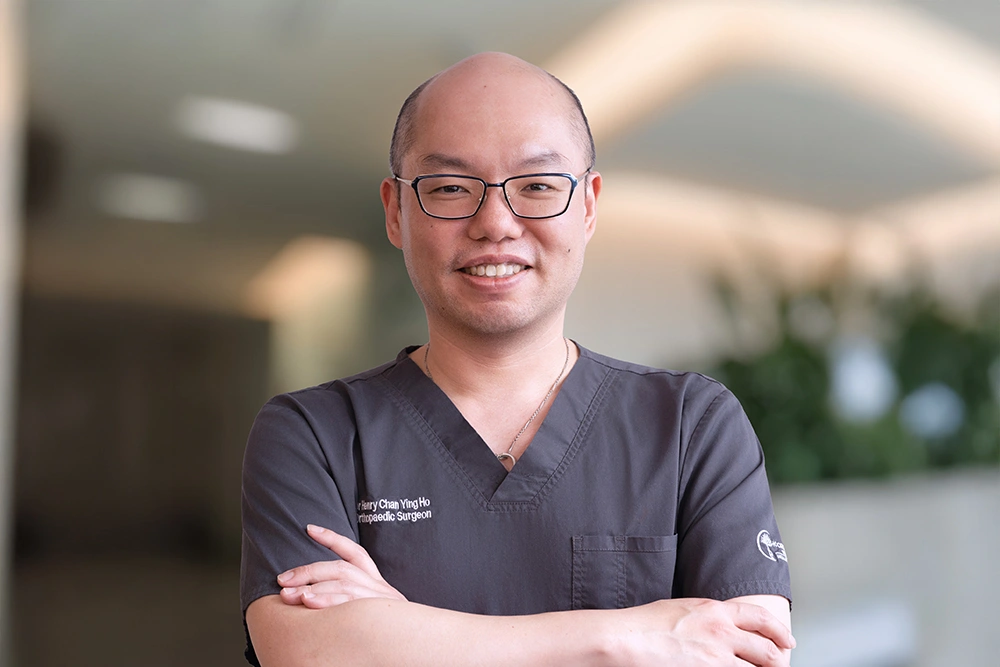
Dr Henry Chan
Medical Director & Senior Consultant Orthopaedic Surgeon
MBBS (S’pore), MRCS (Edinburgh), MMed (Orthopaedic Surgery), FRCS (Edinburgh)
Dr Henry Chan is an experienced orthopaedic surgeon specialising in joint replacement and complex revision surgery. Trained at the renowned Helios Endo-Klinik in Germany under the MOH HMDP scholarship, he has performed over 1,000 joint replacements and specialises in computer-assisted and robotic joint replacement techniques for precise outcomes.
Dr Nicholas Yeoh
Senior Consultant Orthopaedic Surgeon
MBChB (Edinburgh), MRCS (Edinburgh), MMed (Orthopaedic Surgery), FRCS (Edinburgh)
Dr Nicholas Yeoh is an MOH-accredited orthopaedic specialist and Fellow of the Royal College of Surgeons of Edinburgh. Fellowship-trained in hip and knee reconstruction in Sydney under the MOH HMDP scholarship, he specialises in minimally invasive joint replacement, robotic surgery and advanced techniques that enhance recovery and surgical outcomes.
Dr Toon Dong Hao
Senior Consultant Orthopaedic Surgeon
MBChB (Leeds), MRCS (Edinburgh), MMed (Orthopaedic Surgery), FRCS (Edinburgh)
Dr Toon Dong Hao is a skilled orthopaedic surgeon and Fellow of the Royal College of Surgeons of Edinburgh. Fellowship-trained in Advanced Shoulder and Elbow Surgery in Sydney under the MOH HMDP scholarship, Dr Toon specialises in sports injuries, arthroscopic surgery and complex shoulder, elbow and knee procedures to restore function and mobility.
Dr Tang Zhi Hao
Senior Consultant Orthopaedic Surgeon
MBBS (S’pore), MRCS (Edinburgh), MMed (Orthopaedic Surgery), FRCS (Edinburgh)
Dr Tang Zhi Hao is a fellowship-trained orthopaedic surgeon specialising in foot and ankle conditions. He completed his Foot and Ankle Surgery fellowship at Severance Hospital, Yonsei University Health System in Seoul under Professor Jin Woo Lee. Prior to private practice, he served as Consultant and Deputy Head of Orthopaedics at Khoo Teck Puat Hospital.