





A slipped disc is frequently dismissed as standard back pain, yet it represents a structural failure within the spinal column rather than a simple strain. When the annulus fibrosus—the disc’s outer layer—weakens, the jelly-like inner core can bulge or leak outward. This displacement does more than cause soreness; it physically and chemically encroaches on the neural pathways that govern your lower body’s movement and sensation.
The transition from a manageable ache to a neurological crisis can happen rapidly, often without a clear trigger event. Because the spinal canal is a high-traffic environment with little margin for error, even a minor herniation can start a cascade of nerve irritation. Therefore, understanding this mechanical progression is essential to recognising when a back injury has evolved into a serious threat to your long-term mobility and nerve integrity.
The Anatomy of a Disc Failure: From Bulge to Herniation
The clinical impact of a slipped disc is determined by the specific stage of displacement and the degree of neural encroachment. Understanding these mechanical shifts allows for a more accurate assessment of your recovery timeline and potential risks:
The Three Stages of Disc Displacement
- Disc Bulge
The disc bulges outward, but the outer wall remains intact. This creates localised pressure that often manifests as intermittent dull aches or stiffness during specific movements.
- Disc Herniation
The outer ring (annulus) suffers a structural tear, allowing the inner nucleus to escape. This material not only physically pinches the nerve but also triggers a chemical burn, causing sharp, radiating pain.
- Disc Sequestration
A fragment of the nucleus breaks away entirely and may migrate within the spinal canal. This is the most severe stage, as free-floating debris can cause significant, unpredictable neurological interference.
Red Flags: When Symptoms Migrate Beyond the Spine
A slipped disc transitions into a high-priority clinical concern the moment symptoms exit the lower back and travel into the extremities. This migration indicates that the nerve is being actively compressed or chemically irritated, transforming a structural back issue into a complex neurological one.
Sensory Distortions and Peripheral Signals
Patients typically experience a specific cascade of sensory distortions that signal the nerve is under duress, such as the following:
- The Electric Shock Sensation
This is often a sudden, searing pain that shoots down the leg or arm. It occurs when mechanical pressure strikes the nerve, causing a rapid-fire discharge of pain signals along its entire length.
- Paresthesia
More commonly known as pins and needles, this tingling indicates that the nerve’s internal blood supply is being restricted. Persistent paresthesia is a warning that the nerve is struggling to maintain its basic metabolic functions.
- Thermal Changes
Patients may experience localised patches of intense heat or icy coldness in the foot or hand. These sensations are phantom signals sent by irritated sensory fibres that can no longer accurately interpret temperature.
Functional Risks: The Danger of Motor Deficits
The most critical stage of a slipped disc is the transition from pain to loss of control. When compression disrupts motor signals, it moves beyond sensory irritation and becomes a functional deficit that requires urgent intervention from a spine specialist to prevent permanent disability.
Signs of Advanced Nerve Compression
- Muscle Weakness
This often manifests as foot drops, where you struggle to lift the front of your foot, or sudden knee buckling occurs. These are clear indicators that the nerve can no longer effectively recruit the muscle fibres needed for stable movement.
- Reflex Diminution
A noticeable delay or total absence of the standard knee-jerk or ankle reflex during clinical testing suggests a significant break in the electrical circuit between your spine and your limbs.
- Atrophy
Over time, lack of neural stimulation causes the muscle tissue to waste away. Visible shrinking of the calf or thigh muscles is a sign of chronic, severe compression that has moved past the inflammatory stage into structural damage.
The Narrowing Window: Why Early Intervention Prevents Permanent Loss
Adopting a wait-and-see approach when back pain fluctuates is a common mistake, as the window for a full recovery narrows the longer a disc physically encroaches on a nerve.
Seeking a specialist evaluation early is the most effective way to address the injury before sensory or motor deficits become irreversible, by focusing on these three clinical priorities:
- Preventing the Chemical Burn
When a disc herniates, the leaked fluid releases inflammatory proteins that act as a toxin to the nerve. Early intervention neutralises this chemical irritation before it causes permanent scarring, known as fibrosis, around the nerve root.
- Stopping Compensatory Injuries
To avoid sharp pain, your body often adopts an antalgic lean, unconsciously shifting your weight. This imbalance places massive, uneven stress on your opposite hip and knees, often leading to secondary orthopedic wear that persists long after the back pain is resolved.
- The Point of No Return
Nerve fibres are notoriously slow to regenerate compared to muscle or bone. Specialist clinical mapping identifies the specific moment a nerve transitions from being simply irritated to losing its internal architecture, allowing for timely decompression that saves existing muscle volume.
Get a Precise Slipped Disc Diagnosis at HC Orthopaedic Surgery
Ultimately, effectively managing a slipped disc requires a shift in perspective from temporary pain relief to long-term structural preservation. While the initial symptoms may feel like a standard backache, the underlying mechanical failure of the disc can quickly escalate into a neurological crisis if left unaddressed. By recognising early sensory red flags and seeking advanced imaging, you can intervene before nerve irritation transforms into permanent motor loss.

Get a Precise Slipped Disc Diagnosis at HC Orthopaedic Surgery
Ultimately, effectively managing a slipped disc requires a shift in perspective from temporary pain relief to long-term structural preservation. While the initial symptoms may feel like a standard backache, the underlying mechanical failure of the disc can quickly escalate into a neurological crisis if left unaddressed. By recognising early sensory red flags and seeking advanced imaging, you can intervene before nerve irritation transforms into permanent motor loss.

Our Specialised Team
At HC Orthopaedic Surgery, we believe that precision is the key to avoiding unnecessary surgery. Dr Henry Chan and his team, including Dr Nicholas Yeoh, Dr Toon Dong Hao, and Dr Tang Zhi Hao, specialise in correlating high-resolution diagnostic data with your specific functional symptoms to create a targeted recovery roadmap. Whether your condition requires specialised non-surgical decompression or a minimally invasive procedure, our goal is to restore your mobility and protect your spinal health.
Don't wait for muscle weakness or numbness to dictate your lifestyle. Contact our clinic today to schedule a comprehensive spinal assessment and take the first step toward a pain-free future.
Frequently Asked Questions (FAQs) About Slipped Discs
Can a slipped disc heal on its own without surgery?
What activities should I avoid with a slipped disc?
How do I know if my slipped disc is an emergency?
Meet Our Slipped Disc Specialist in Singapore
Our team comprises Dr Henry Chan, Dr Nicholas Yeoh, Dr Toon Dong Hao, and Dr Tang Zhi Hao — experienced orthopaedic surgeons with subspecialty experience and a patient-centred approach to care.
Dr Henry Chan
Medical Director & Senior Consultant Orthopaedic Surgeon
MBBS (S’pore), MRCS (Edinburgh), MMed (Orthopaedic Surgery), FRCS (Edinburgh)
Dr Henry Chan is an experienced orthopaedic surgeon specialising in joint replacement and complex revision surgery. Trained at the renowned Helios Endo-Klinik in Germany under the MOH HMDP scholarship, he has performed over 1,000 joint replacements and specialises in computer-assisted and robotic joint replacement techniques for precise outcomes.
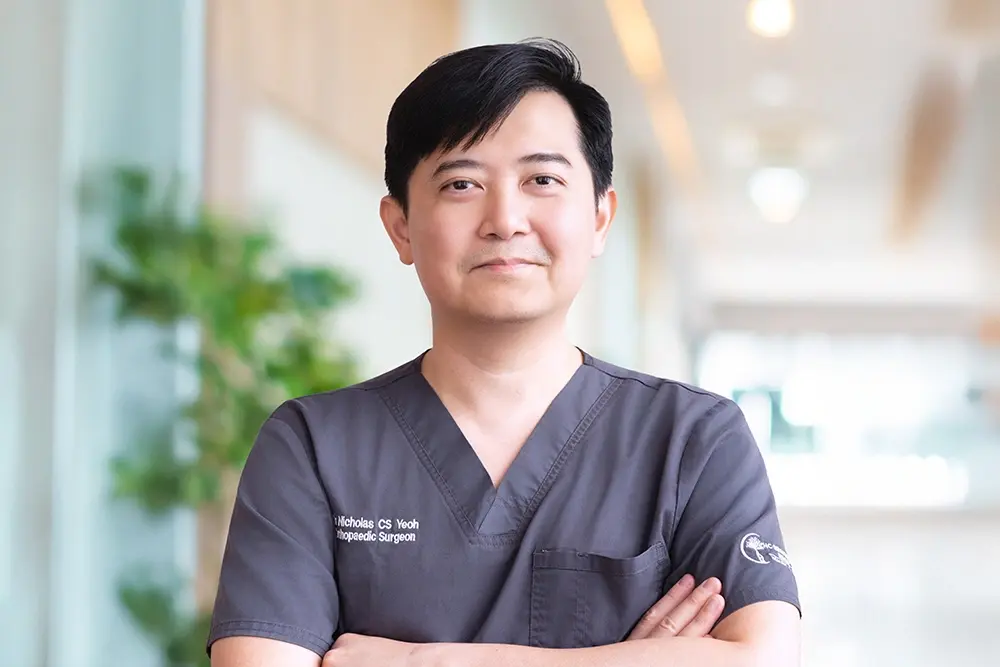
Dr Nicholas Yeoh
Senior Consultant Orthopaedic Surgeon
MBChB (Edinburgh), MRCS (Edinburgh), MMed (Orthopaedic Surgery), FRCS (Edinburgh)
Dr Nicholas Yeoh is an MOH-accredited orthopaedic specialist and Fellow of the Royal College of Surgeons of Edinburgh. Fellowship-trained in hip and knee reconstruction in Sydney under the MOH HMDP scholarship, he specialises in minimally invasive joint replacement, robotic surgery and advanced techniques that enhance recovery and surgical outcomes.
Dr Toon Dong Hao
Senior Consultant Orthopaedic Surgeon
MBChB (Leeds), MRCS (Edinburgh), MMed (Orthopaedic Surgery), FRCS (Edinburgh)
Dr Toon Dong Hao is a skilled orthopaedic surgeon and Fellow of the Royal College of Surgeons of Edinburgh. Fellowship-trained in Advanced Shoulder and Elbow Surgery in Sydney under the MOH HMDP scholarship, Dr Toon specialises in sports injuries, arthroscopic surgery and complex shoulder, elbow and knee procedures to restore function and mobility.
Dr Tang Zhi Hao
Senior Consultant Orthopaedic Surgeon
MBBS (S’pore), MRCS (Edinburgh), MMed (Orthopaedic Surgery), FRCS (Edinburgh)
Dr Tang Zhi Hao is a fellowship-trained orthopaedic surgeon specialising in foot and ankle conditions. He completed his Foot and Ankle Surgery fellowship at Severance Hospital, Yonsei University Health System in Seoul under Professor Jin Woo Lee. Prior to private practice, he served as Consultant and Deputy Head of Orthopaedics at Khoo Teck Puat Hospital.